Experiment Update
G. Joel Hager · May 2026 · your-next-hire.me
In my earlier analysis of filtering and rejection technology in modern hiring systems,[1] I argued that what we call Applicant Tracking Systems should more honestly be called what they are: filtering and rejection technology. That piece reached 59,000 people on LinkedIn and generated more than 500 reactions and 228 comments — which told me I had touched something real.
This is the follow-up. Not a think piece. A data update.
Since October 2024, I have been running a structured experiment: submitting different resume variants to different types of applications, tracking the outcomes, and using AI assistance to decide which version to submit based on both the job description and the application system being used. I am now seven months in, with 219 applications on the board. The data is not encouraging — for me, or for the system generating it.
One note before the numbers: in early May 2026, the experiment paused briefly when I was rushed to the emergency room and required an emergency thrombectomy. My discharge instructions were activity as tolerated — keep moving, increase gradually — which is directly reflected in why remote and hybrid positions are weighted so heavily in this search. The experiment is back underway. I wrote about that experience separately here. I mention it only because the pause is in the data, and because it underscores something I keep coming back to: the human cost of a hiring system that demands this level of documentation just to be seen.
The Numbers
Here is where things stand as of this writing. These figures come directly from my custom-built job application tracker, which logs every submission, every outcome, and every application that has aged past 90 days with no response.
- 219 -Total Submitted
- 87 – Still Active
- 59 – Total Rejections (excl. ghosted)
- 28 – Auto Rejections
- 28 – Post Review Period
- 3 – Confirmed Human
- 73 – Ghosted
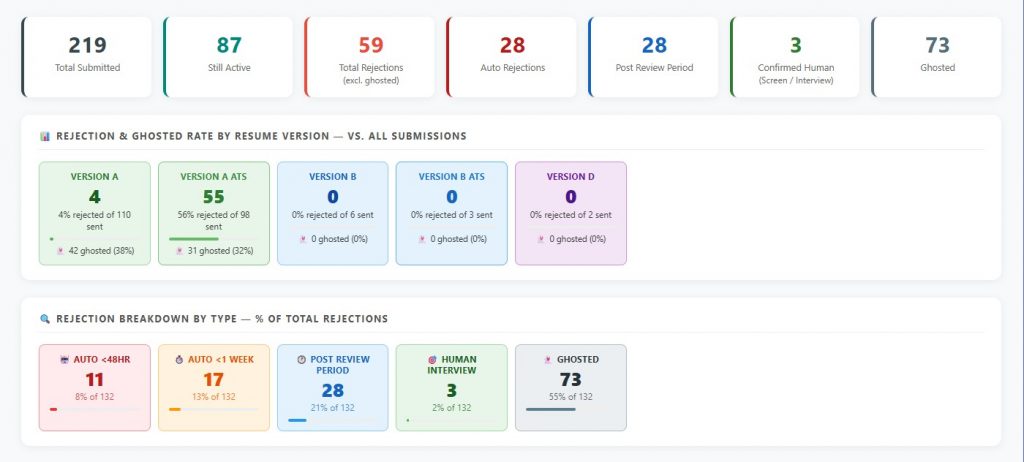
The math checks out: 59 rejections + 73 ghosted + 87 still active = 219 total submitted. Of the 132 applications that have reached a terminal state — meaning they either received a rejection or aged out at 90 days with no response — 73 of them, or 55.3%, ended in silence. Measured against all 219 submissions, the ghosting rate is 33.3% and climbing as more active applications age past the 90-day threshold.
On the denominator
Both rates are true and both are useful. The 55.3% figure reflects what actually happened among resolved applications — more than half ended with no communication at all. The 33.3% figure reflects the overall submission picture, including applications still technically open. As those active applications continue to age, the overall ghosting rate will likely rise. It is currently a floor, not a ceiling.
Breaking Down the Rejections
Of the 59 actual rejections received, the breakdown reveals something worth examining:
- 🤖 Auto-rejection within 48 hours11 · 8% of archived
- ⏱️ Auto-rejection within 1 week17 · 13% of archived
- 🕐 Post Review Period28 · 21% of archived
- 🎯 Confirmed Human (post-interview)3 · 2% of archived
- 👻 Ghosted — 90-day auto-archive73 · 55% of archived
A note on the “Post Review Period” category: these are rejections that arrived more than one week but fewer than 90 days after submission. Whether they represent a human reviewer or a slower automated screening process is genuinely unknowable from the outside. Calling them “human rejections” would be claiming more certainty than the data supports. The timing puts them outside the window that is almost certainly automated, but well within the range that an ATS configured to batch-process rejections on a monthly cycle could produce. The label is intentionally agnostic.
What is not agnostic: only 3 applications — out of 219 — resulted in confirmed human contact at the interview stage. That is a 1.4% interview rate.
The Variant Strategy
The core premise of the experiment is that different application pathways warrant different resume presentations, and that submitting the same document everywhere is leaving signal on the table — or feeding it to systems optimized to reject it. I developed five primary resume variants:
Resume Versions in the Experiment
Version A — Full resume, all dates. Used for direct applications, recruiter submissions, and company website portals where a human is likely the first reader.
Version A ATS — Full resume, ATS-formatted. Plain structure, no tables or columns, optimized for machine parsing. Used for structured portals like Workday and Taleo.
Version B / B ATS — Five-year history with and without dates. Used where recency is valued or where full history may trigger age-adjacent screening.
Version D — The word cloud: a dense, visually styled PDF of 104 weighted, color-coded keywords designed to stress-test keyword-matching systems rather than parse cleanly. Used for one-click and Easy Apply submissions where the profile, not the document, does the heavy lifting.
I am using AI to assist with version selection. For each application, I provide the job description and the application platform to Perplexity AI, which recommends a version based on the role’s language and system type. I cross-check anything that does not feel right here with Claude. The decision logic prioritizes: Is this Workday or Taleo? Use the ATS-formatted version. Is this an Easy Apply or one-click system? Version D. Is this a direct company portal or recruiter submission where a person is likely the first reader? Version A. I am not following AI recommendations blindly — the instructions I gave the AI reflect deliberate choices I made based on months of observation, and the AI advice is not always consistent. But having a second read on each submission has sharpened the targeting.
The Variant Data
Here is how each version performed across the submissions in this experiment. “Rejection rate” excludes ghosted applications. “Ghosted rate” reflects submissions that aged past 90 days with no response, as a percentage of that version’s total submissions.
| Version | Sent | Rejected | Rej. Rate | Ghosted | Ghost Rate | Active |
|---|---|---|---|---|---|---|
| A Full Resume | 110 | 44 | 40% | 42 | 38% | 24 |
| A ATS ATS Full | 98 | 55 | 56% | 31 | 32% | 12 |
| B 5-Year Dated | 6 | 0 | 0% | 0 | 0% | 6 |
| B ATS ATS 5-Year | 3 | 0 | 0% | 0 | 0% | 3 |
| D Word Cloud | 2 | 0 | 0% | 0 | 0% | 2 |
A few observations worth calling out explicitly:
The Version A ATS rejection rate of 56% is the highest in the dataset. This is the version specifically designed to pass through ATS parsing cleanly. The fact that it has the highest rejection rate of any version in active use is either a finding about keyword matching (the structured format is being screened more aggressively) or a reflection of where it is being deployed — structured portals like Workday and Taleo, which may simply be configured to reject more aggressively. Likely both.
Versions B, B ATS, and D show 0% rejection and 0% ghosting — but the sample sizes are 6, 3, and 2 respectively. This is not a finding. This is an insufficient sample, and the experiment is ongoing. These numbers will change.
The Version A and A ATS data together represent 208 of 219 submissions — the overwhelming majority of the dataset. Between them: 99 rejections, 73 ghosted entries, and 36 still active. Combined ghosted rate: 35%.
Why I Am Skipping Certain Applications Entirely
I want to address something that is not in the data because it is a deliberate exclusion: I am refusing to apply to any position that requires me to create a new account with the employer’s application platform.
This is not about signing in. If I already have an account, or if a platform offers OAuth authentication via Google, LinkedIn, or another established identity provider, that is acceptable. What I am refusing is the pattern of an employer deploying an ATS instance that requires every applicant to create fresh credentials — username, password, email verification — solely for the purpose of submitting a single application to a single company.
My objections are two-fold. First, the applicant experience is bad. A process that requires account creation before it will accept my resume is telling me something about how the organization thinks about friction for people who are not yet employees. That is useful information about the employer.
Second, and more seriously: the data privacy implications of scattering credentials and personal information across dozens of poorly configured, under-secured ATS instances are not trivial. Research consistently shows that ATS platforms are high-value targets for data breaches,[2] and that weak encryption accounts for 72% of ATS security incidents.[3] A 2025 PwC survey found that 62% of candidates worry about how employers manage their personal information,[4] and GDPR mandates limit retention of candidate data to six months without additional consent — a rule that a surprising number of U.S.-based systems are not designed to honor at all.
Requiring account creation for every application instance is not a feature. It is a lazy configuration choice that trades applicant convenience and data security for implementation simplicity on the employer’s side. I am choosing not to participate in it, and I am not counting those roles in my rejection data, because I never applied.
Ghosting Is Not a Side Effect. It Is the Primary Response.
Let me state this clearly: of every application that has reached a terminal state in my tracker, more than half ended with no communication whatsoever. Ghosting is not an anomaly in this data. It is the modal outcome.
This is consistent with what the broader research shows. A 2025 Criteria survey found that 53% of job seekers experienced employer ghosting within the last year, a figure that has now reached a three-year peak.[5] A Greenhouse 2024 State of Job Hunting report found that 61% of job seekers had been ghosted after a job interview — a nine percentage point increase since April 2024 alone — with historically underrepresented candidates experiencing even higher rates.[6] An iHire 2025 survey of over 1,000 candidates found that 59.7% cited ghosting as a top frustration, with 28% reporting silence specifically at the application stage — before any interview contact at all.[7]
The most common explanation offered for rising ghosting rates is that AI-assisted mass applications have flooded recruiter inboxes, making it operationally impossible to respond to everyone. Greenhouse data shows recruiter workload increased by 26% in Q4 2024 alone, with 38% of job seekers now mass-applying to roles.[6] This is real. But it is also worth noting that the same organizations deploying ATS systems capable of auto-rejecting within 48 hours are capable of sending an automated acknowledgment or a standardized decline. The technology exists. The choice not to use it is a choice.
The Ghost Job Problem Underneath the Ghosting Problem
There is a second layer to this that I want to name, even though I cannot quantify it in my own data: a meaningful percentage of the roles I and other job seekers are applying to may never have been real.
Ghost jobs — positions advertised with no genuine intention to hire — have become a documented, large-scale feature of the job market. A September 2025 analysis by ResumeUp.AI found that 27.4% of all U.S. job listings on LinkedIn are likely ghost jobs, with Los Angeles reaching 30.5%.[8] A January 2025 Clarify Capital study found that nearly one in three employers admit to posting listings with no intention of hiring.[9] The Congressional Research Service formally defined ghost job postings in an April 2025 report as “online job postings for positions that do not exist or that employers are not planning to fill.” [10]
The motivations are varied: talent pipeline building for future openings, signaling growth to investors during earnings cycles, market testing to see which keywords and titles attract qualified candidates, compliance posting requirements, and in some cases deliberate data harvesting of candidate resumes.[11] A Fast Company-sponsored recruiter survey found that 81% of recruiters have posted ghost jobs, with over a third saying up to 25% of their active listings are non-actionable. [9]
BLS data makes this visible at scale: since the beginning of 2024, job openings have outnumbered actual hires by more than 2.2 million per month. An analysis of June 2025 BLS data found employers reported 7.4 million openings but made only 5.2 million hires — meaning roughly one in three posted roles never resulted in a hire at all. [12]
I cannot tell you how many of my 73 ghosted applications were to ghost jobs. No one can, from the outside. But the data strongly suggests it is not zero.
What This Means for the Data
If between 18% and 27% of job listings are ghost jobs,[11] and my ghosting rate among resolved applications is 55%, some portion of that 55% may represent applications to positions that were never going to result in a response because the position was never real. The ghosting I am experiencing is likely a compound number: some portion is employers who received my application and chose not to respond; some portion is employers who posted the role with no hiring intent and were never going to respond regardless of what I submitted.
The experiment cannot distinguish between these two causes. That is itself a finding. A hiring system that makes it impossible for candidates to tell the difference between a slow response and a fake posting is not malfunctioning. It is working exactly as designed for the parties who benefit from the ambiguity.
A Critical Caveat: The Resume Revisions
Before drawing any conclusions from the version data above, there is something that needs to be stated plainly: virtually all of that data was generated with an older set of resume documents.
The May 1 hospitalization did more than pause the experiment. It prompted a harder look at how I was presenting myself. Somewhere between the ER and recovery, the question became unavoidable: if something had gone differently that day, what would my professional record actually show for this period? The answer was not satisfying.
I brought the question directly to both Claude and Perplexity: given the full scope of what I do in my volunteer and community leadership roles, was I underselling myself? Both said yes, independently, after reviewing what I was actually doing. Not “you could frame this better.” Yes — you are underselling this.
The core problem was how my volunteer and community leadership work was framed — or more accurately, how it was not being framed at the level it deserves. I have been serving as Regional Venture-Coordinator for the Appalachian Region of Paizo Organized Play since 2025, holding top authority across a 6-state footprint with promotion and demotion responsibility over a multi-tier volunteer structure and direct reporting accountability to national leadership. I chair a global onboarding committee serving 18 international regions. I directed the product specification and QA of a production regional health dashboard on a React/Supabase/Vercel/Cloudflare stack, at zero incremental budget. None of this is hobbyist activity. It is active operational and technical leadership at real organizational scale — and the prior documents were not saying so.
On May 15, 2026, the revised documents went into active use.
What This Means for the Data
The 56% rejection rate on Version A ATS, the 40% rejection rate on Version A, the 55% ghosting rate among resolved applications — all of that is pre-revision data. It reflects what happened with documents that were not representing the full picture. Whether the revised materials perform materially differently is something the data will answer over time. As of this writing, we have six days of post-revision submissions to look at.
Six Days of Post-Revision Data
The revised documents went into active use on May 15, 2026. Here is every submission and outcome in the six days since:
| Applied | Employer | Role | Version | Outcome |
|---|---|---|---|---|
| 5/15/2026 | Gravie | Manager, Member Services Optimization | A | Rejected — Auto <1 week (5/18) |
| 5/15/2026 | Insight Global | Enterprise Systems Support Manager | A ATS | Active |
| 5/18/2026 | Harvey | Support Operations Manager, User Operations | A | Active |
| 5/18/2026 | Benepass | Product Operations Manager | A ATS | Active |
| 5/18/2026 | Coretelligent | Senior Enterprise Applications Manager | A ATS | Active |
| 5/18/2026 | Jobot | Business Analyst | A ATS | AI interview → AI recruiter call → pending human review |
| 5/18/2026 | MasterCard | Manager, Enablement & Operations (R-278216) | A ATS | Rejected — Auto <48 hrs (5/20) |
| 5/19/2026 | OpenSesame | Manager of Information Technology | A ATS | Rejected — Auto <48 hrs (5/21) |
| 5/19/2026 | Headway | Manager, Business Operations | A ATS | Active |
| 5/20/2026 | Toast | IT Delivery Manager | A | Rejected — Auto <48 hrs (5/22) |
| 5/20/2026 | MediaSource | Operations Program Manager | A ATS | Active |
| 5/21/2026 | Coretelligent | Senior IT Project Manager | A | Active |
| 5/21/2026 | AlphaSense | Senior Manager, User Operations | A | Active |
| 5/22/2026 | Airbnb | Program Manager, Community Support | A ATS | Active |
Fourteen submissions in six days. Four rejections, all automated — three within 48 hours, one within a week. Ten still active. The Jobot submission warrants a separate note.
After submitting, I was immediately presented with an AI-conducted interview on their platform — structured questions, text responses, no human involved. That was followed almost immediately by a phone call from their AI recruiter, which conducted a spoken screening conversation. At the end of that call, the AI recruiter informed me it was passing my details to the hiring manager, who would be in touch if they felt my skills met their needs. No human contact occurred at any stage. The entire screening process — from application to handoff decision — was conducted by AI systems. Whether a human hiring manager ever reviews what those systems passed along remains to be seen.
This is worth noting not because it is unusual, but because it is becoming usual. The Jobot interaction is the most visible example in this dataset of AI operating as a complete gatekeeper — not assisting a human reviewer, but replacing one entirely through the screening phase. The “confirmed human contact” category in my tracker requires actual human interaction. The Jobot process, as experienced, does not yet qualify.
It is far too early to draw conclusions from six days of data. What I can say is that all four rejections were automated, which means the revised documents have not yet been seen by a confirmed human reviewer in any case where a decision was made. That may change as the active applications age. It may not. The experiment continues.
The honest summary
A hospitalization that prompted a hard look at how I was representing myself. Two AI systems independently confirming the underselling. Seven months of data generated with documents that were not telling the full story. A revision on May 15 that corrects that. Six days of post-revision submissions with one AI-gated pipeline experience and four automated rejections. The pre-revision data tells you what those documents produced. The post-revision data is just starting. Check back.
Where the Experiment Goes From Here
The experiment is ongoing. The B and D variant sample sizes are too small to draw conclusions from, and I am actively expanding them. The AI-assisted selection process is being refined as I gather more data on which platforms respond to which versions.
I will continue tracking, continue publishing, and continue being specific about the math. The tracker itself is a custom-built HTML/JavaScript application — data is stored in localStorage for persistence, exportable to CSV at any time, importable to merge records across multiple devices or instances, and cross-referenced against a separate archive file that holds rejected and ghosted applications. It is not a commercial product. It is what I built because nothing that existed did exactly what I needed.
If you are running a similar experiment, or if you are an employer who wants to understand what the experience looks like from the other side of your ATS, I would be glad to hear from you.
— G. Joel Hager
joel@your-next-hire.me · linkedin.com/in/joelhager
Bibliography
[1]Hager, G. Joel. “Filtering and Rejection Tech: How Modern Hiring Systems Erase Humans, Hide Qualified Candidates, and Harm Our Health.” your-next-hire.me, 2025. Link
[2]CVViZ. “Is Your ATS Secure? Top Data Privacy Risks in Recruitment.” CVViZ Blog, June 2025. Link
[3]Scale.jobs. “5 Best Practices for Candidate Data Security in ATS.” Scale.jobs Blog, February 2026. Link
[4]Applicantz. “Candidate Data Protection: Why It Matters in 2025.” Applicantz Blog, November 2025. Link
[5]Burleigh, Emma. “Job Seekers Aren’t Imagining Things: The Number of Candidates Ghosted by Employers Just Reached a Three-Year High Thanks to AI.” Fortune, 2025. Link
[6]Greenhouse. “Ghosting, Ghost Jobs and Bots: Candidates Reveal Their Top Challenges in the Greenhouse 2024 State of Job Hunting Report.” Greenhouse Blog, December 2024. Link
[7]Kelly, Kristina. “53% of Job Seekers Have Been Ghosted by a Potential Employer.” iHire Hiring Newsroom, October 2025. Link
[8]”One-Quarter of Jobs Posted Online Are Fake Ghost Jobs: Study.” Entrepreneur, January 2026. Citing ResumeUp.AI analysis. Link
[9]DAVRON. “Ghost Jobs & Misleading Job Ads Are Still Rising.” DAVRON Blog, July 2025. Citing Clarify Capital (January 2025) and Fast Company recruiter survey. Link
[10]Congressional Research Service. Definition of ghost job postings as cited in: FastApply. “Ghost Jobs Are Wasting Your Time: How to Spot Fake Job Postings in 2026.” FastApply Blog, 2026. Link
[11]MintCareer. “Ghost Jobs in 2026: Statistics and How to Spot Them.” MintCareer Blog, April 2026. Aggregating research from 2024–2025 estimating 18–27% of listings are ghost jobs. Link
[12]CNBC. “‘Ghost Job’ Postings Are Adding Another Layer of Uncertainty to the Stalling Jobs Picture.” CNBC, November 2025. Citing Bureau of Labor Statistics data. Link
© 2026 G. Joel Hager · Mableton, GA · your-next-hire.me