The Meeting That Almost Killed Me
Sedentary corporate culture, deep vein thrombosis, and what I rebuilt in recovery.
On May 1, 2026, I was rushed to the emergency room with shortness of breath, dizziness, lightheadedness, and the feeling that I was about to lose consciousness. The diagnosis was a saddle pulmonary embolism, caused by deep vein thrombosis — blood clots in my legs. The intervention was an emergency thrombectomy, removing 8 to 12 inches of blood clots from my pulmonary arteries.
I survived. Not everyone does.
The ER nurse who cared for me was a former combat medic. Someone trained to stay clinical under pressure, to assess and act without flinching. He kept impressing on me how dire the situation was. And at one point, he asked if he could pray for me — as though he was not entirely certain I would make it — while simultaneously telling me I was in the right place, with the right team, to have any chance at all.
When a combat medic asks to pray for you, you understand the stakes without needing a statistic.
In the weeks since, I’ve had a lot of time to think about how it happened, what I share responsibility for, and what the structure of modern corporate work contributed to. This piece is the result of that thinking — and of the research I did to understand whether what happened to me was a fluke or a documented pattern.
It is not a fluke.
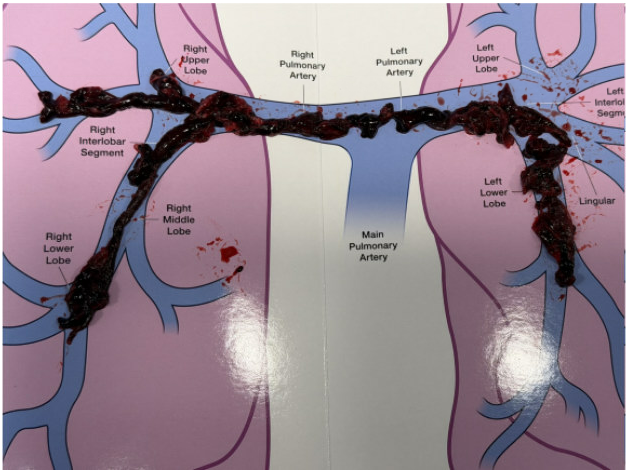
The blood clots removed during my emergency thrombectomy on May 1, 2026. 8 to 12 inches of material extracted from my pulmonary arteries. This is what prolonged sedentary immobility can produce in a human body.
The Medical Reality of Sitting All Day
Deep vein thrombosis occurs when blood clots form in the deep veins, most commonly in the legs. When those clots break loose and travel to the lungs, the result is pulmonary embolism — which can be fatal. The two conditions together are known as venous thromboembolism (VTE). A saddle pulmonary embolism, specifically, is a clot that straddles the main pulmonary artery — one of the most dangerous presentations of the condition.
The connection between prolonged sitting and DVT has been documented in peer-reviewed literature for decades. In 1940, Dr. Keith Simpson observed elevated rates of fatal pulmonary embolism in people sitting for extended periods in London air raid shelters during the Blitz — the first formal documentation of what we now understand as the sitting-clot connection.1
More recent research has quantified the risk with precision. A case-control study published in the Journal of the Royal Society of Medicine found a 1.8 to 2.8-fold increased risk of DVT and pulmonary embolism associated with prolonged seated immobility at work and computer use.2 A cohort study of over 389,000 Danish workers found that sedentary occupations carried significantly higher rates of venous thromboembolism compared to physically active work.3 A separate meta-analysis of eight prospective cohort studies found that working 55 or more hours per week was associated with a hazard ratio of 1.7 for deep vein thrombosis — a 70% increased risk.4
One study found that a third of patients hospitalized with DVT were office workers who had spent long periods sitting at computers.5 Sedentary office workers are explicitly identified in peer-reviewed literature as a high-risk population for DVT — alongside long-haul truck drivers, air travelers, and post-surgical patients.6
I sat at a desk, in meetings, for years. I take responsibility for my own lifestyle choices that compounded that risk. And I am also saying clearly: the structure of my work made it easy to sit for hours without movement, and hard to do anything about it.
The Meeting Culture Problem
If you work in corporate America, you know the schedule: back-to-back meetings from early morning to late afternoon, with no structural gaps, no movement breaks, no acknowledgment that the human beings in those meetings have bodies that require something other than sustained seated attention.
I’m not naming companies. I don’t need to. If the description fits your calendar, you know who you are.
What I will say is that this is not an individual failure. It is a systemic one. When an organization structures the workday in a way that makes basic physical movement structurally impossible — when getting up to walk for five minutes means missing something, being seen as not engaged, or falling behind — the organization has made a choice about employee well-being. That choice has consequences.
“The organization has made a choice about employee well-being. That choice has consequences.”
And a standing desk is not enough. This point is worth stating explicitly because it is the most common corporate response to sedentary work concerns. Providing a sit-stand desk and calling it a wellness initiative does not address meeting culture. If your calendar is wall-to-wall video calls, you are still stationary — you are just stationary while standing. The physiological risk from prolonged immobility is not about posture. It is about movement. Blood needs to circulate. Muscles need to contract. A standing desk does not accomplish this if you are standing in place for eight hours staring at a screen.
The research confirms the broader picture. According to a 2025 Gallup study, two-thirds of full-time workers report experiencing burnout on the job.7 Meeting overload is a documented driver — when workers are forced to continuously context-switch through back-to-back meetings, they lose focus, accumulate fatigue, and have no time for recovery.8 Harvard Business Review has estimated that loneliness and disengagement cost U.S. companies up to $154 billion annually in lost productivity.9
Some companies are responding. Shopify deleted thousands of recurring meetings and freed up over 322,000 hours of employee time. LinkedIn designated Wednesdays as no-meeting days. The head of Instagram recently told staff in a company-wide memo: “We all spend too much time in meetings that are not effective, and it’s slowing us down.”10 These are not radical interventions. They are basic recognitions that the people doing the work are human beings with finite cognitive and physical resources. The fact that they are newsworthy tells you something about how low the bar has been set.
The return-to-office movement compounds this problem directly. Remote work, for all its critiques, gave many workers something the office had long denied them: structural flexibility. The ability to stand up between calls. To walk to a different room. To exist in a space where movement was not automatically interpreted as absence. RTO mandates eliminate that flexibility, extend the sedentary period with commute time on both ends, and reinforce the culture of constant visible availability that makes it socially difficult to decline a meeting or take a movement break. The research on sedentary work risk applies with full force to anyone chained to an office desk. Mandating that people return to that environment — without addressing the meeting culture that makes it dangerous — is not a wellness initiative. It is the opposite.
What I Did During the Gap
I left JPMorgan Chase in October 2025 when my position was eliminated. What followed was seven months I initially described as an employment gap — and have since stopped describing that way.
During that period, while conducting an active job search, I:
- Continued serving as Regional Operations Director for a 6-state organized play program, managing a multi-tier volunteer structure with direct reporting accountability to national organizational leadership
- Chaired a global committee serving organized play participants across 18 international regions worldwide
- Directed the design and deployment of a production operational intelligence dashboard built on React, Supabase, Node.js, Vercel, and Cloudflare — at zero incremental budget
- Built and managed two WordPress community sites serving thousands of players
- Designed and operated a 13-applet automated content distribution network
- Provided independent operations consulting for a media company
- Published a research-backed analysis of ATS hiring systems that reached 59,000+ impressions on LinkedIn within 30 days
And on May 1, 2026, I had an emergency thrombectomy.
The work didn’t stop. Recovery meant doing it differently — more movement, more flexibility, more attention to what my body was telling me. The remote work environment I had during the gap made that possible. It is a significant part of why I am now describing remote work as non-negotiable rather than merely preferred.
What I Rebuilt
When I look back at how I was describing myself professionally before this period — the resume, the portfolio, the LinkedIn profile — I was doing something I’ve seen many capable people do: describing extraordinary work in ordinary language. Using passive constructions. Burying the lead. Apologizing with my word choices for taking up space.
A former colleague looked at everything I’d built and told me I was dramatically underselling myself.
They were right.
I rebuilt everything. The resume. The portfolio. Five resume variants engineered for different application contexts and audiences. A new website with updated case studies, a deep-dive portfolio page, and an executive summary that actually reflects the scope of what I’ve done. A LinkedIn profile that tells the truth about the level I operate at.
Not because the work changed. The work was always there. Because I finally had the time, the perspective, and the near-death experience required to stop describing it the way someone who doesn’t believe they deserve to take up space would.
What Needs to Change — And What You Can Do Now
If you work in HR, people operations, or manage a team: I ask you to look at your meeting culture. Not as an abstract wellness initiative, but as a concrete health and liability question. The research is clear. Prolonged sedentary work is a documented risk factor for life-threatening clotting conditions. If your organization’s calendar makes movement structurally impossible, you are operating in documented risk territory. A standing desk program is not a substitute for a culture that allows people to move.
If you are currently working in a back-to-back meeting culture: Learn to protect your own time. Decline meetings that don’t require your presence. Block time on your calendar for movement. Stand up between calls. Walk during lunch. I understand the social pressure that makes this feel impossible — I lived it. I am asking you to fight that pressure harder than I did, because the alternative is what happened to me. Your employer will replace you. The people who depend on you cannot.
Listen to your body. If something feels wrong — unusual shortness of breath, leg pain, swelling, dizziness — do not wait. Do not finish the meeting. Do not send one more email. Go to the emergency room. The ER nurse who cared for me was a former combat medic who asked if he could pray for me. He believed I might not survive. I did. Not because I waited — because I went when I did. Earlier would have been better. Later might have been fatal.
On health insurance: I have received a five-figure medical bill so far, and it is still climbing. I do not have health insurance. I lost it when I lost my job. COBRA exists on paper as a continuation option — in practice, the premiums are unaffordable for anyone who is unemployed. The system designed to help you keep coverage when you lose your job costs more per month than most people’s rent.
So let me be precise about what happened: I was laid off from a job that was contributing to a life-threatening medical condition. Losing that job also eliminated my access to affordable healthcare. And then the medical condition that job helped cause nearly killed me, leaving me with a five-figure bill I am responsible for paying without insurance, while still unemployed.
That is not a gap in the system. That is the system working exactly as designed — for everyone except the person who needs it most.
A system that ties health coverage to employment means the people most likely to be grinding through sedentary, meeting-heavy workdays are the same people whose access to care disappears the moment that job ends. Losing your job should not mean losing your ability to treat the condition your job helped cause. Universal healthcare is not a political luxury. For many people in this situation — and I am now one of them — it is the difference between getting care and financial ruin.
I will be on blood thinners and related medications for a minimum of six months. I am actively researching lower-cost options including the Mark Cuban Cost Plus Drugs program and other alternatives, because I have no insurance and no choice. If you have navigated this and have recommendations, I genuinely welcome them.
I am actively seeking remote or hybrid operations leadership roles. Remote is non-negotiable — not because I can’t work hard, but because I need a work structure that is physically compatible with not dying. That is not a dramatic statement. It is a medical one.
If you know of roles in strategic operations, program management, regional leadership, or service management — remote or genuinely hybrid — I welcome the connection.
If you’ve experienced something similar — a health event you traced back to a sedentary work environment — I want to hear from you. This conversation is worth having out loud.
Full professional portfolio and updated resume: your-next-hire.me
Bibliography
- Simpson K. Shelter deaths from pulmonary embolism. The Lancet. 1940;2:744.
- Healy B, Levin E, Perrin K, Weatherall M, Beasley R. Prolonged work- and computer-related seated immobility and risk of venous thromboembolism. Journal of the Royal Society of Medicine. 2010;103(11):447–454. https://pmc.ncbi.nlm.nih.gov/articles/PMC2966881/
- Braekkan SK, Borch KH, Mathiesen EB, Njølstad I, Wilsgaard T, Hansen JB. Jobs encompassing prolonged sitting in cramped positions and risk of venous thromboembolism. Thrombosis Research. 2012;129(4):e269–e273. https://pmc.ncbi.nlm.nih.gov/articles/PMC3291423/
- Kivimäki M, Nyberg ST, Batty GD, et al. Long working hours and risk of venous thromboembolism. Epidemiology. 2018;29(6):e50–e51. https://pmc.ncbi.nlm.nih.gov/articles/PMC6072371/
- Peacock N. Can your desk job give you DVT? LinkedIn Pulse. August 2020. https://www.linkedin.com/pulse/can-your-desk-job-give-you-dvt-neil-peacock
- Groce JB. Deep vein thrombosis. American Journal of Managed Care. 2001;7(17 Suppl):S510–S515. https://pubmed.ncbi.nlm.nih.gov/18792613/
- Gallup. State of the Global Workplace: 2025 Report. Cited in: Rio Grande Guardian/Stacker. January 2026. https://riograndeguardian.com/premium/stacker/stories/solving-for-burnout
- Ibid. Meeting overload as documented driver of burnout and cognitive fatigue.
- Harvard Business Review. Loneliness costs U.S. companies up to $154 billion annually. Cited in multiple 2025 workplace analyses including Rio Grande Guardian/Stacker, January 2026.
- Mosseri A. Company-wide memo on meeting reduction. Instagram/Meta, 2026. Cited in: Rio Grande Guardian/Stacker. January 2026. https://riograndeguardian.com/premium/stacker/stories/solving-for-burnout
The full story is here. The resume is here. The work is here.
If you’re a hiring manager, recruiter, or someone who found this through LinkedIn — everything you need is at your-next-hire.me.
View Portfolio View Resume Get in Touch